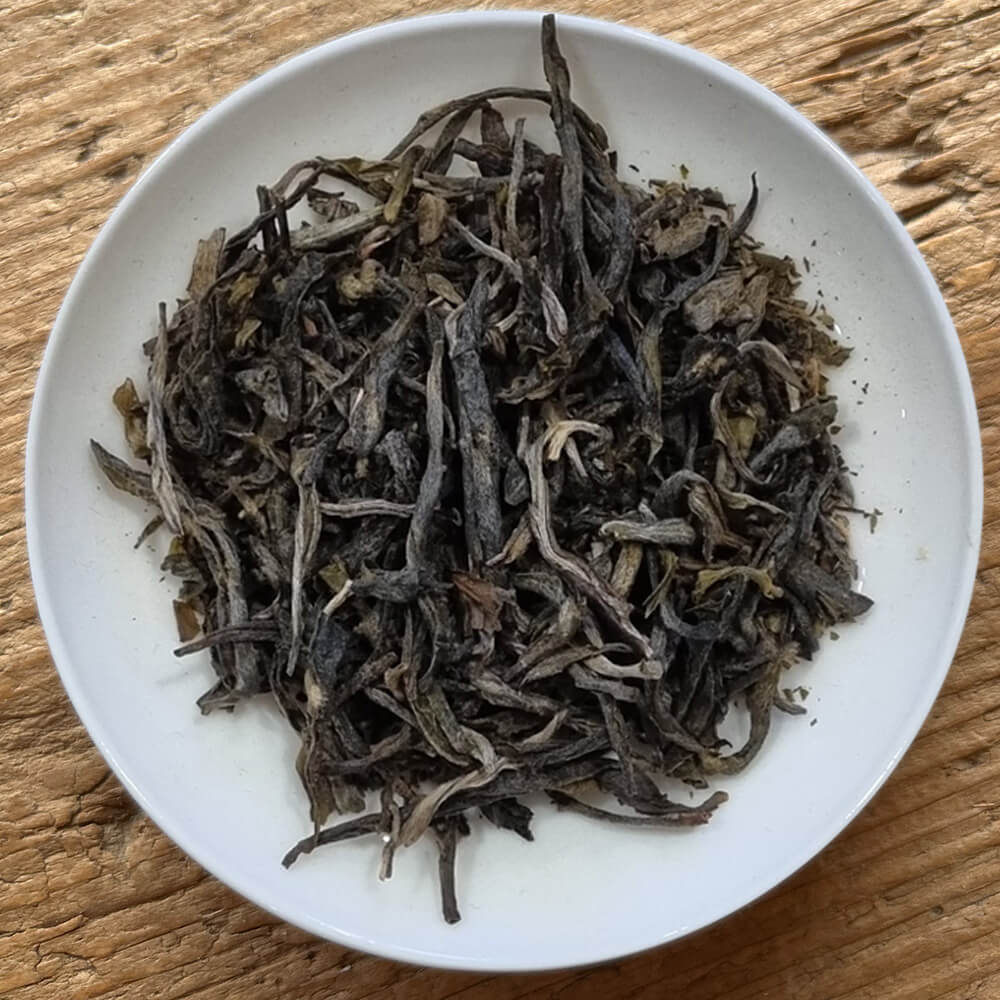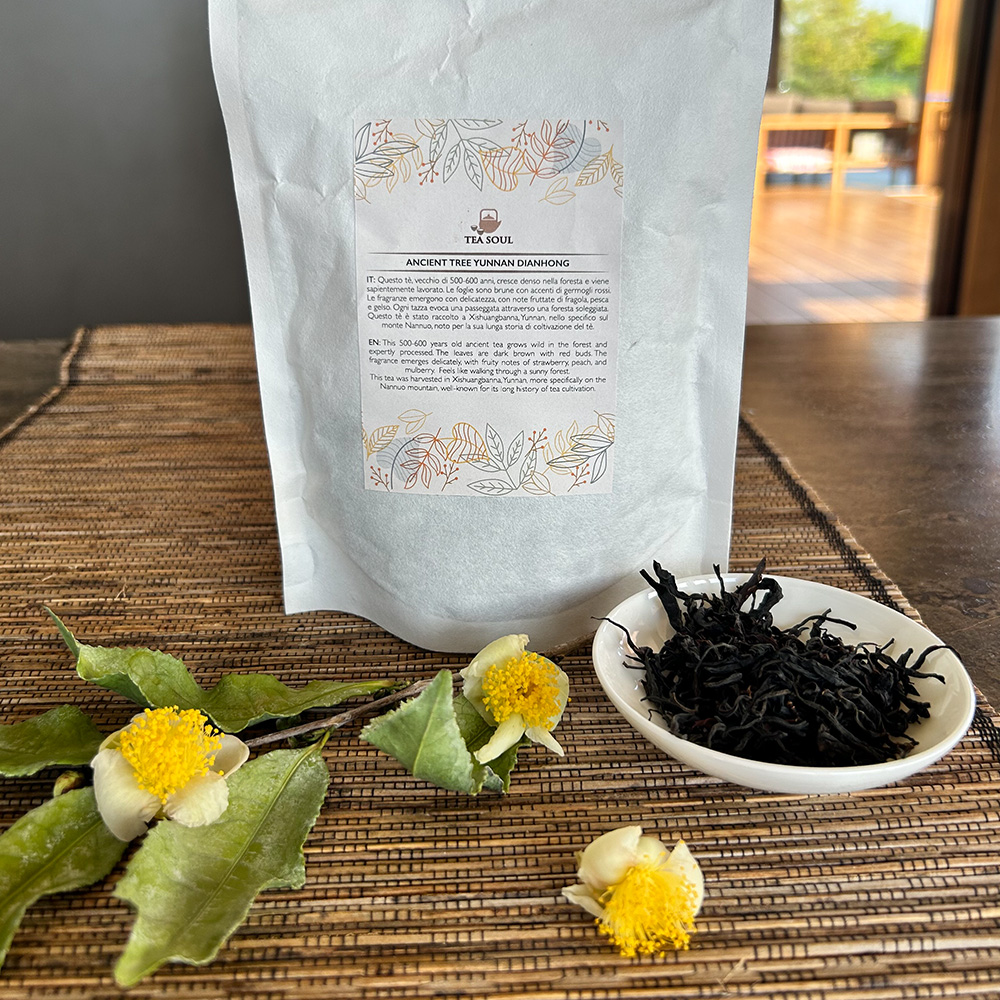
The Dianhong Ancient Trees Red (Black) Tea, harvested from ancient trees 500-600 years old, grows dense in the forest and is skillfully processed. The leaves are brown with accents of red and golden buds. Its fragrances emerge delicately, with fruity notes of strawberry, peach, and mulberry. Each cup evokes a walk through a sunny forest. This tea was harvested in Xishuangbanna, Yunnan, specifically on Nannuo mountain, known for its long history of tea cultivation. The whole leaves of Dianhong Ancient Trees, with a tapered and gently rolled shape, are brown with coppery tips. On the nose, sweet and fruity notes of peach and strawberry jam can already be perceived, while, once infused, the peach gives way to warmer and enveloping scents of cacao and rose. The amber liquor in the cup is sweet and fruity on the nose. The first infusion in a gaiwan of Dianhong Ancient Trees reveals an extremely complex yet perfectly balanced tea: the opening on the first sip is smooth, with notes of cacao, spicy wood, heather honey, and rose hip. The floral note then evolves into aromas of red fruits (currant, raspberry) and peach, which returns at the end and closes with a long and sweet persistence. With the second and third infusions, the floral notes make way for cacao, honey, and peach that become dominant. On the palate, it is a sweet, round, and enveloping tea, free of astringency and bitterness. In the western style, this is undoubtedly an extremely complex yet perfectly balanced tea: the opening on the first sip is smooth with sweet notes of cacao and heather honey. These warmer notes evolve on the palate, first revealing fruity scents of peach and lychee and then floral scents of rose and hints of incense. The persistence is long and sweet, with a distinct note of peach at the end. A tea with a remarkable body, incredibly enveloping and velvety, free of bitterness and astringency, characterized by sweet and fruity notes. Origin: Nannuo Mountain - Yunnan, China. We highly recommend infusing this tea using the traditional Chinese method (Gong Fu Cha) with a gaiwan of about 150 ml capacity. Following this preparation, with 5 grams of leaves you can make multiple infusions to capture all the nuances of flavor of the tea. Heat the water to a temperature of 90°C and proceed with a first infusion of 20 seconds. Keeping the water at the same temperature, you can continue to use the same leaves by adding more water and increasing the infusion time by 5 seconds each time (20 - 25 - 30…). This tea has a longevity of 6-8 infusions. For a more classic preparation according to the western style, we recommend 3 grams of leaves (about 2 teaspoons) in a 200 ml cup with water at 90°C for an infusion time of 3 minutes. For a better tasting experience, we suggest filtering the brew just after the infusion time is completed. The infusion times we suggest can also be slightly modified to your liking to obtain a more or less intense taste. It is recommended to store in a cool and dry place away from direct sunlight.
Price VAT included







The Dianhong Ancient Trees Red (Black) Tea, harvested from ancient trees 500-600 years old, grows dense in the forest and is skillfully processed. The leaves are brown with accents of red and golden buds. Its fragrances emerge delicately, with fruity notes of strawberry, peach, and mulberry. Each cup evokes a walk through a sunny forest. This tea was harvested in Xishuangbanna, Yunnan, specifically on Nannuo mountain, known for its long history of tea cultivation. The whole leaves of Dianhong Ancient Trees, with a tapered and gently rolled shape, are brown with coppery tips. On the nose, sweet and fruity notes of peach and strawberry jam can already be perceived, while, once infused, the peach gives way to warmer and enveloping scents of cacao and rose. The amber liquor in the cup is sweet and fruity on the nose. The first infusion in a gaiwan of Dianhong Ancient Trees reveals an extremely complex yet perfectly balanced tea: the opening on the first sip is smooth, with notes of cacao, spicy wood, heather honey, and rose hip. The floral note then evolves into aromas of red fruits (currant, raspberry) and peach, which returns at the end and closes with a long and sweet persistence. With the second and third infusions, the floral notes make way for cacao, honey, and peach that become dominant. On the palate, it is a sweet, round, and enveloping tea, free of astringency and bitterness. In the western style, this is undoubtedly an extremely complex yet perfectly balanced tea: the opening on the first sip is smooth with sweet notes of cacao and heather honey. These warmer notes evolve on the palate, first revealing fruity scents of peach and lychee and then floral scents of rose and hints of incense. The persistence is long and sweet, with a distinct note of peach at the end. A tea with a remarkable body, incredibly enveloping and velvety, free of bitterness and astringency, characterized by sweet and fruity notes. Origin: Nannuo Mountain - Yunnan, China. We highly recommend infusing this tea using the traditional Chinese method (Gong Fu Cha) with a gaiwan of about 150 ml capacity. Following this preparation, with 5 grams of leaves you can make multiple infusions to capture all the nuances of flavor of the tea. Heat the water to a temperature of 90°C and proceed with a first infusion of 20 seconds. Keeping the water at the same temperature, you can continue to use the same leaves by adding more water and increasing the infusion time by 5 seconds each time (20 - 25 - 30…). This tea has a longevity of 6-8 infusions. For a more classic preparation according to the western style, we recommend 3 grams of leaves (about 2 teaspoons) in a 200 ml cup with water at 90°C for an infusion time of 3 minutes. For a better tasting experience, we suggest filtering the brew just after the infusion time is completed. The infusion times we suggest can also be slightly modified to your liking to obtain a more or less intense taste. It is recommended to store in a cool and dry place away from direct sunlight.