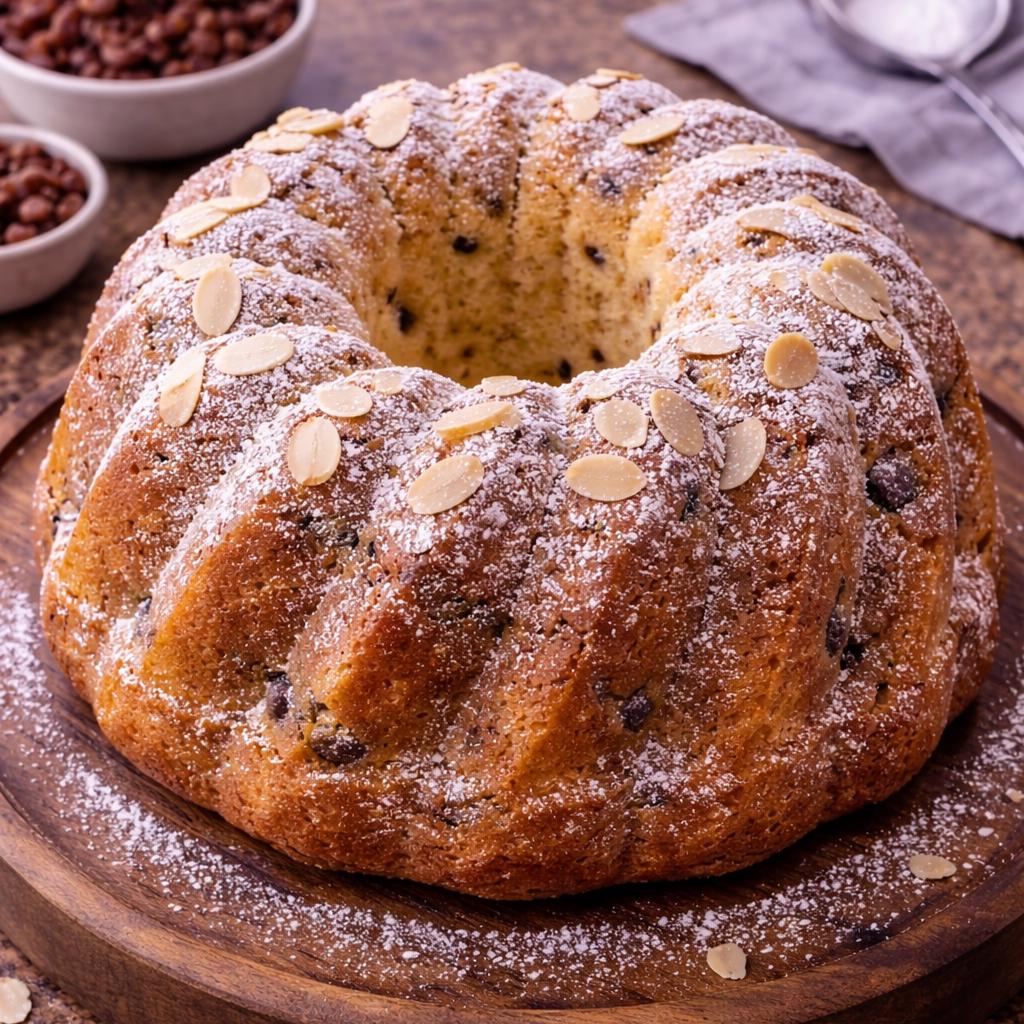
Kugelhupf is a traditional Central European cake, originating from Austria. This soft ring-shaped cake is enriched with sultana raisins and sliced almonds. Perfect to enjoy at breakfast or as a tasty afternoon treat!









All the ingredients for the dough must be lukewarm: if necessary, immerse the bowl in which you will place them in hot water and dry it well before pouring in the flour
Take the butter and eggs out of the refrigerator well in advance
Dissolve the yeast in lukewarm milk, add 2 tablespoons of flour and let rest in a warm place until the mixture has puffed up
In the warmed bowl pour in the flour, salt and sugar and mix
Make a well in the center, add the eggs and the softened butter and work with a wooden spoon, then combine this mixture with the well-risen yeast
Knead the dough by hand for a long time then let it rise in the bowl covered with a floured cloth in a warm place
(If it's cold, ideally turn the oven on to the lowest setting for 5 minutes, turn it off and put the bowl inside)
When the dough has risen (the time can vary from 30 minutes to an hour) and has doubled in volume, turn it out onto the work surface and work it with your hands to deflate it
Then put it back in the bowl covered and keep it in the refrigerator overnight
The next day butter a kugelhupf pan and sprinkle it with sliced almonds
Soak the raisins in lukewarm water for one hour
Put the dough into the pan (it should be filled two-thirds) and add the drained raisins: they will sink into the dough as it rises
Place in a warm oven until the dough has reached the edges of the pan, then bake at moderate temperature for 45 minutes
The kugelhupf is ready when it comes away from the sides of the pan
Then remove it from the pan and sprinkle with powdered sugar
Kugelhupf pan
Austria
| Energy (kcal) | 441.17 |
| Carbohydrates (g) | 55.85 |
| of which Sugars (g) | 19.16 |
| Fat (g) | 22.55 |
| of which Saturates (g) | 12.58 |
| Protein (g) | 6.41 |
| Fiber (g) | 1.64 |
| Sale (g) | 0.35 |
