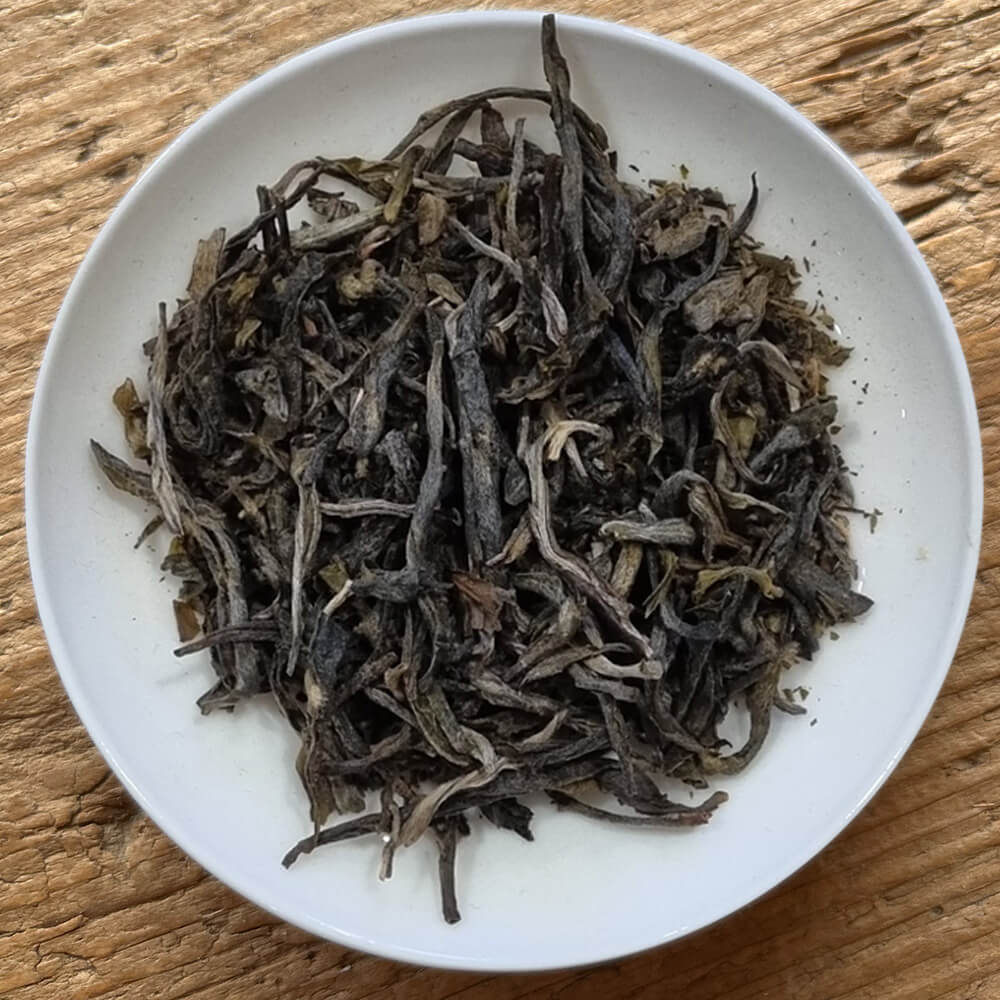
Anji Bai Cha green tea comes from the famous Chinese region of Zhejiang. If we pause for a moment on the name of this tea, we can see that it contains the particle "bai" which means "white". This word is not meant to confuse us regarding the type of tea we are drinking, but instead, it speaks to us of its origins. Anji Bai Cha green tea is characterized by coming from an albino cultivar, Bai Ye Yin Hao. These types of camellia are more suited for producing white tea, but in the past, the processing in the style of green tea in Zhejiang impressed consumers so much that we still find Anji Bai Cha in production today. The tea obtained from the raw materials of Bai Ye Yi Hao, harvested during the whitening phase, has an unusual chemical composition. It contains less chlorophyll, which explains the color, but this does not affect the flavor: chlorophyll is insoluble and does not contribute to the taste and aroma of the tea. Anji Bai Cha contains much less caffeine and other purine alkaloids compared to normal green teas; significantly fewer polyphenols - only 10-14%; significantly more amino acids - up to 6-7% and in some cases up to 10%, which is many times higher than normal green teas. This makes Anji Bai Cha a refreshing, sweet-tasting brew, with a pronounced mind and minimal astringency and bitterness. In the cup, the liquor presents a delicate, complex flavor profile that is very fresh. The vegetal character combined with the soft body of this tea gives a sensation of freshness similar to that perceived in a meadow early in the morning, when it is still possible to see the dew on the grass and feel the humidity rising from the ground. Anji Bai Cha green tea features whole buds and leaves rolled longitudinally, with a very long, thin, and crispy body. The dry aroma is already intense, with roasted notes and a sweet hint reminiscent of beeswax. The color is a bright meadow green mixed with a more muted yellow-green. Once infused, the leaves release aromas of roasted nuts like almonds and cashews, sweet vegetal notes (carrots and young peas), and a very elegant floral note in the finish. The liquor in appearance is pale yellow, almost transparent, very bright and clear. The opening of this Anji Bai Cha green tea is surprisingly salty and sweet together, with a decidedly high body for a green tea. A sweet note of beeswax and delicate vegetal nuances reminiscent of fresh fava beans, asparagus tips and steamed carrots is then perceived. The finish is slightly floral. As the infusions progress, a truly remarkable umami emerges along with a salty flavor that overall evokes nuts like pistachios and cashews. There is also a sweet boiled chestnut note at the end. The floral part becomes more prominent with subsequent infusions, increasingly reminding us of the vibrancy and freshness of wildflowers. Bitterness and astringency are completely absent, with a dense and silky body. Long salty persistence, with harmonious vegetal notes lingering on the tongue. Anji Bai Cha green tea has a very classic processing method which involves, after an initial withering outdoors, the cooking of the leaves in large woks heated to around 180°C to stop the enzymatic activity and prevent oxidation. After these phases, the leaves receive their final shape and are left to rest to lose a little of their residual humidity inside. We strongly recommend infusing Anji Bai Cha green tea in the traditional Chinese method (gong fu cha) to best enjoy these leaves. Following this preparation, you can use 5 grams of leaves (about 3 teaspoons) in a gaiwan of about 150 ml to achieve multiple infusions with different flavors. With water heated to 75°C, you can proceed to a first infusion of 25 seconds and, keeping the water at the same temperature, continue with more infusions increasing each time the time by 10 seconds (25 - 35 - 45 ...). This tea has a longevity of about 5 infusions. For a classic preparation in the Western style, we recommend 3 grams of leaves (about 1 and a half teaspoons) in a 200 ml cup with water at 75°C for an infusion time of 3 minutes. The tea can be filtered for greater ease during tasting, and the suggested infusion times are meant to be purely indicative, so you can adjust based on your personal taste. It is advised to store in a cool, dry place away from direct sunlight.
Price VAT included







Anji Bai Cha green tea comes from the famous Chinese region of Zhejiang. If we pause for a moment on the name of this tea, we can see that it contains the particle "bai" which means "white". This word is not meant to confuse us regarding the type of tea we are drinking, but instead, it speaks to us of its origins. Anji Bai Cha green tea is characterized by coming from an albino cultivar, Bai Ye Yin Hao. These types of camellia are more suited for producing white tea, but in the past, the processing in the style of green tea in Zhejiang impressed consumers so much that we still find Anji Bai Cha in production today. The tea obtained from the raw materials of Bai Ye Yi Hao, harvested during the whitening phase, has an unusual chemical composition. It contains less chlorophyll, which explains the color, but this does not affect the flavor: chlorophyll is insoluble and does not contribute to the taste and aroma of the tea. Anji Bai Cha contains much less caffeine and other purine alkaloids compared to normal green teas; significantly fewer polyphenols - only 10-14%; significantly more amino acids - up to 6-7% and in some cases up to 10%, which is many times higher than normal green teas. This makes Anji Bai Cha a refreshing, sweet-tasting brew, with a pronounced mind and minimal astringency and bitterness. In the cup, the liquor presents a delicate, complex flavor profile that is very fresh. The vegetal character combined with the soft body of this tea gives a sensation of freshness similar to that perceived in a meadow early in the morning, when it is still possible to see the dew on the grass and feel the humidity rising from the ground. Anji Bai Cha green tea features whole buds and leaves rolled longitudinally, with a very long, thin, and crispy body. The dry aroma is already intense, with roasted notes and a sweet hint reminiscent of beeswax. The color is a bright meadow green mixed with a more muted yellow-green. Once infused, the leaves release aromas of roasted nuts like almonds and cashews, sweet vegetal notes (carrots and young peas), and a very elegant floral note in the finish. The liquor in appearance is pale yellow, almost transparent, very bright and clear. The opening of this Anji Bai Cha green tea is surprisingly salty and sweet together, with a decidedly high body for a green tea. A sweet note of beeswax and delicate vegetal nuances reminiscent of fresh fava beans, asparagus tips and steamed carrots is then perceived. The finish is slightly floral. As the infusions progress, a truly remarkable umami emerges along with a salty flavor that overall evokes nuts like pistachios and cashews. There is also a sweet boiled chestnut note at the end. The floral part becomes more prominent with subsequent infusions, increasingly reminding us of the vibrancy and freshness of wildflowers. Bitterness and astringency are completely absent, with a dense and silky body. Long salty persistence, with harmonious vegetal notes lingering on the tongue. Anji Bai Cha green tea has a very classic processing method which involves, after an initial withering outdoors, the cooking of the leaves in large woks heated to around 180°C to stop the enzymatic activity and prevent oxidation. After these phases, the leaves receive their final shape and are left to rest to lose a little of their residual humidity inside. We strongly recommend infusing Anji Bai Cha green tea in the traditional Chinese method (gong fu cha) to best enjoy these leaves. Following this preparation, you can use 5 grams of leaves (about 3 teaspoons) in a gaiwan of about 150 ml to achieve multiple infusions with different flavors. With water heated to 75°C, you can proceed to a first infusion of 25 seconds and, keeping the water at the same temperature, continue with more infusions increasing each time the time by 10 seconds (25 - 35 - 45 ...). This tea has a longevity of about 5 infusions. For a classic preparation in the Western style, we recommend 3 grams of leaves (about 1 and a half teaspoons) in a 200 ml cup with water at 75°C for an infusion time of 3 minutes. The tea can be filtered for greater ease during tasting, and the suggested infusion times are meant to be purely indicative, so you can adjust based on your personal taste. It is advised to store in a cool, dry place away from direct sunlight.