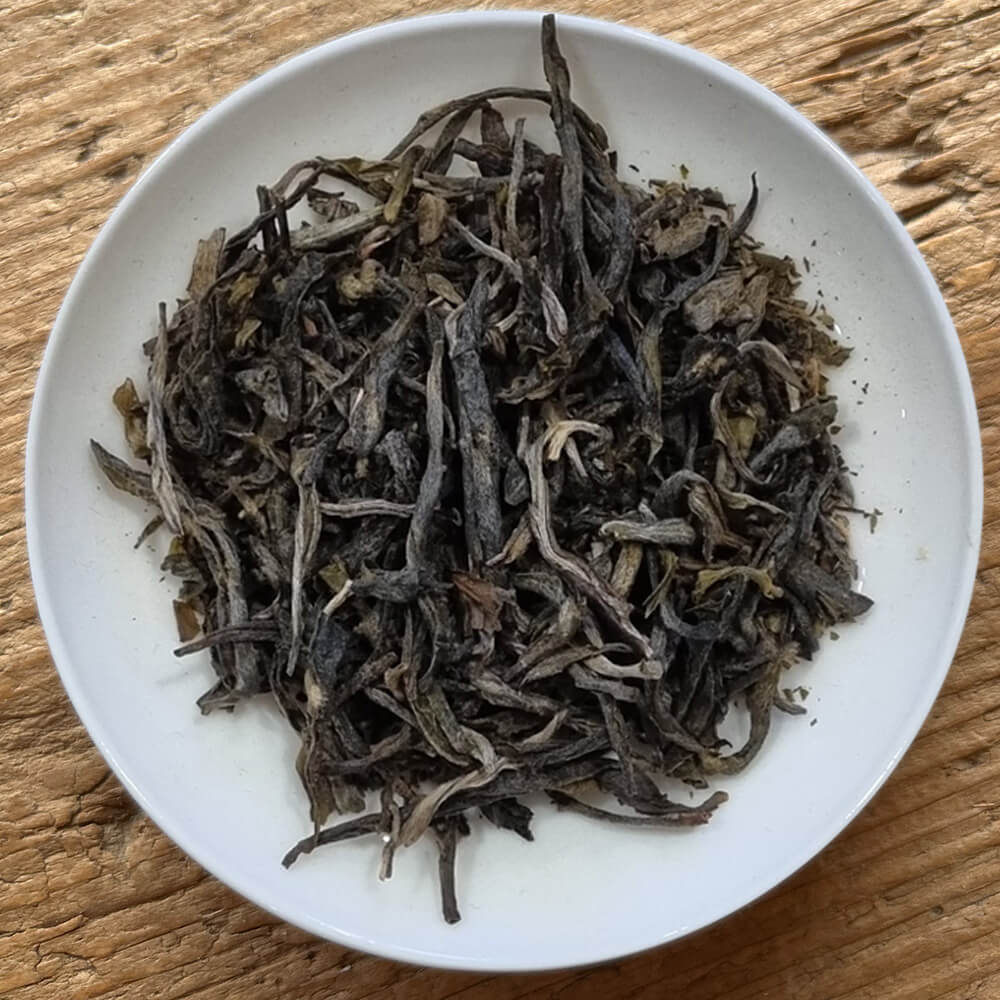






The Oolong Dong Ding Tea from Vietnam is a refined meeting between Taiwanese tradition and the soul of the Vietnamese terroir. Its leaves, sourced from the Jin Xuan cultivar (also known as Milk Oolong for its natural sweetness), are carefully picked and processed according to a method that reproduces the classic style of Dong Ding from Taiwan, but with its own identity, more fruity and velvety. This tea originates from the Son La district in northern Vietnam, at an altitude of about 1,000–1,200 meters, in a garden cultivated according to permaculture principles. The tea trees grow in small groups, interspersed with flowers and fruit trees (like plums and oranges), creating a harmonious and naturally balanced ecosystem. It is not an industrial monoculture but a project of artisanal and sustainable enhancement, aimed at restoring Vietnam to its historical role as the "land of tea". Sensory profile: The infusion appears amber and clear, with golden reflections. Aromas of butter and roasted notes emerge, followed by hints of ripe red fruits and a slight floral vein that adds elegance and freshness. On the palate, the texture is velvety and dense, with a full and rounded body. The taste opens with warm and gourmand tones, evolving into a sweet and persistent finish, devoid of bitterness or astringency. The long aromatic persistence leaves a silky sensation and a fruity trail reminiscent of cooked plum and melted butter, typical of the best roasted Oolongs. This balance between aromatic depth and floral freshness reflects the perfect fusion between Taiwanese craftsmanship and the lively character of the Vietnamese mountains. Place of origin: Son La district – northern Vietnam. Origin and characteristics of the territory: The Son La district is about ten hours from Hà Giang, in a mountainous region with a mild and humid climate. The plantations extend between 1,000 and 1,200 meters in altitude, where the cool air and morning mist favor a slow maturation of the leaves and a high aromatic concentration. The permaculture cultivation allows for the coexistence of different species: tea, flowers, and fruit trees live together in the same space, enriching the soil and fostering biodiversity. This approach, away from intensive models, results in a pure, expressive tea that is respectful of the environment. Production: The leaves are hand-picked, selecting buds with two or three leaves. After a phase of natural wilting, the tea undergoes oxidation of about 80%, a high level that gives it the deep and round character typical of Dong Ding. A light roasting follows, performed using a technique adapted by the Vietnamese tea master trained in Taiwan, with over forty years of experience. This phase enhances the buttery softness and red fruit tones while maintaining the clarity and elegance of the aromatic profile. The project arises from a direct collaboration with this artisan master, whose production, previously reserved for the Taiwanese market, is now accessible thanks to a relationship of trust and friendship built over time. Each batch is limited and exclusive, the result of a human and cultural dialogue that reflects in every cup. Preparation: We strongly recommend infusing this tea using the traditional Chinese method (gong fu cha) to best enjoy these leaves. Following this preparation, you can use 5 grams of leaves (about 3 teaspoons) in a gaiwan of about 150 ml to obtain multiple infusions with different flavors. After a quick rinse of the leaves in water at 85 °C, you can proceed with a first infusion of 15 seconds, and thereafter, keeping the water at the same temperature, you can increase the time by 5 seconds compared to the previous infusion (15 – 20 – 25 …) This tea has a longevity of about 6 infusions. For a classic preparation according to the Western style, we recommend 3 grams of leaves (about 2 teaspoons) in a 200 ml cup with water at 85 °C for an infusion time of one and a half minutes. If you wish to experiment with infusions of this tea with different amounts of leaves, try to think about the suitable quantity to allow the leaf to expand freely in the liquid without being compressed or hindered. By doing so, you will maximize this product without hindering the extraction of flavorful substances. The tea can be filtered for easier tasting, and the indicated infusion times are meant to be purely indicative, so you can adjust according to your personal taste. It is recommended to store in a cool, dry place, away from direct sunlight.

The Oolong Dong Ding Tea from Vietnam is a refined meeting between Taiwanese tradition and the soul of the Vietnamese terroir. Its leaves, sourced from the Jin Xuan cultivar (also known as Milk Oolong for its natural sweetness), are carefully picked and processed according to a method that reproduces the classic style of Dong Ding from Taiwan, but with its own identity, more fruity and velvety. This tea originates from the Son La district in northern Vietnam, at an altitude of about 1,000–1,200 meters, in a garden cultivated according to permaculture principles. The tea trees grow in small groups, interspersed with flowers and fruit trees (like plums and oranges), creating a harmonious and naturally balanced ecosystem. It is not an industrial monoculture but a project of artisanal and sustainable enhancement, aimed at restoring Vietnam to its historical role as the "land of tea". Sensory profile: The infusion appears amber and clear, with golden reflections. Aromas of butter and roasted notes emerge, followed by hints of ripe red fruits and a slight floral vein that adds elegance and freshness. On the palate, the texture is velvety and dense, with a full and rounded body. The taste opens with warm and gourmand tones, evolving into a sweet and persistent finish, devoid of bitterness or astringency. The long aromatic persistence leaves a silky sensation and a fruity trail reminiscent of cooked plum and melted butter, typical of the best roasted Oolongs. This balance between aromatic depth and floral freshness reflects the perfect fusion between Taiwanese craftsmanship and the lively character of the Vietnamese mountains. Place of origin: Son La district – northern Vietnam. Origin and characteristics of the territory: The Son La district is about ten hours from Hà Giang, in a mountainous region with a mild and humid climate. The plantations extend between 1,000 and 1,200 meters in altitude, where the cool air and morning mist favor a slow maturation of the leaves and a high aromatic concentration. The permaculture cultivation allows for the coexistence of different species: tea, flowers, and fruit trees live together in the same space, enriching the soil and fostering biodiversity. This approach, away from intensive models, results in a pure, expressive tea that is respectful of the environment. Production: The leaves are hand-picked, selecting buds with two or three leaves. After a phase of natural wilting, the tea undergoes oxidation of about 80%, a high level that gives it the deep and round character typical of Dong Ding. A light roasting follows, performed using a technique adapted by the Vietnamese tea master trained in Taiwan, with over forty years of experience. This phase enhances the buttery softness and red fruit tones while maintaining the clarity and elegance of the aromatic profile. The project arises from a direct collaboration with this artisan master, whose production, previously reserved for the Taiwanese market, is now accessible thanks to a relationship of trust and friendship built over time. Each batch is limited and exclusive, the result of a human and cultural dialogue that reflects in every cup. Preparation: We strongly recommend infusing this tea using the traditional Chinese method (gong fu cha) to best enjoy these leaves. Following this preparation, you can use 5 grams of leaves (about 3 teaspoons) in a gaiwan of about 150 ml to obtain multiple infusions with different flavors. After a quick rinse of the leaves in water at 85 °C, you can proceed with a first infusion of 15 seconds, and thereafter, keeping the water at the same temperature, you can increase the time by 5 seconds compared to the previous infusion (15 – 20 – 25 …) This tea has a longevity of about 6 infusions. For a classic preparation according to the Western style, we recommend 3 grams of leaves (about 2 teaspoons) in a 200 ml cup with water at 85 °C for an infusion time of one and a half minutes. If you wish to experiment with infusions of this tea with different amounts of leaves, try to think about the suitable quantity to allow the leaf to expand freely in the liquid without being compressed or hindered. By doing so, you will maximize this product without hindering the extraction of flavorful substances. The tea can be filtered for easier tasting, and the indicated infusion times are meant to be purely indicative, so you can adjust according to your personal taste. It is recommended to store in a cool, dry place, away from direct sunlight.
Price VAT included