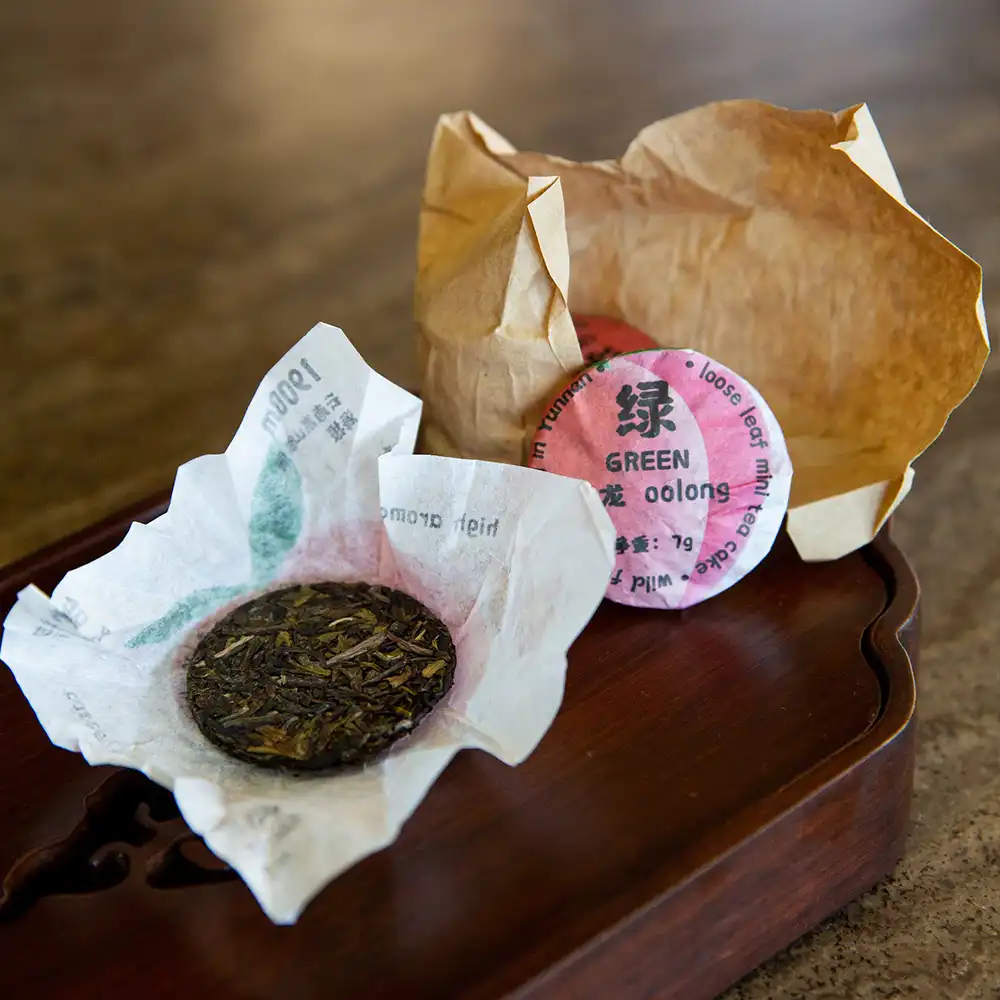
The Oolong Tea Mini Cakes Green comes from the Jinxuan and Ruanzhi cultivars in Taiwan, but its leaves, from wild tree forests, grow on Mount Dahei, in the famous Pu'er (Yunnan) province. Before proceeding with the oxidation blocking (killing green), there is a key phase in the processing of oolong called shaking, which means "shaking the fresh leaves": this step, in addition to initiating oxidation through the impact of the leaves against each other and causing a first cellular break, ensures that all the water in the stem spreads evenly into the leaves through the veins that run through them. This step also intensifies the aromas, fixing them. Each package contains seven mini cakes of 7 grams each. Tasting - Sight and smell The mini cake green oolong tea appears as a cake 4 cm in diameter and round in shape, composed of pressed and very compact leaves of various shades of green, from dark forest green to light green, olive green, and military green, with some leaves in beige tones. Once infused, the cake releases enveloping aromas of resin, fruits such as quince, yellow peach, and pear flesh, incense, aromatic wood, and a light finish reminiscent of leather. The color of the liquor is an intense yellow-orange, with amber reflections, very bright and quite transparent. Tasting Notes GONG FU CHA The first infusion of the Mini Cake Green oolong tea has surprising notes that almost suggest a young sheng: incense, pine wood, and resin, with a fruity sweetness in the background. With the second infusion, the balsamic notes intensify, and the fruity hints with notes of ripe pear become clearer. The third infusion and the following ones reveal notes of camphor and again incense, with a fruity finish, showing an interesting, dynamic, and certainly peculiar aromatic profile for an oolong tea. The body is of medium density and quite dry: there is a certain astringency in the finish, which leaves a pleasant feeling of cleanliness in the mouth. The persistence is long, with notes of incense and dry wood that evoke the memory of an autumn walk in the woods. Place of origin Pu'er, Yunnan, China. Infusion method We strongly recommend infusing the Mini Cakes Green oolong tea using the traditional Chinese method (Gong Fu Cha) with a gaiwan with a capacity of about 200 ml. Following this preparation, with 7 grams of leaves, multiple infusions can be made to fully appreciate all the flavors of the tea. After a quick rinse of the leaves with water at a temperature of 90°C, a first infusion of 40 seconds can be made, and then, keeping the water at the same temperature, the product can continue to be used by adding more water and increasing the previous infusion time by about 10 seconds. This tea allows for about 4-5 infusions. The infusion times we suggest can still be adjusted slightly to your liking to achieve a more or less intense flavor. It is recommended to store in a cool, dry place away from direct sunlight. Benefits of Oolong tea The main benefits that can be derived from oolong teas come from the significant content of minerals and antioxidant phenols present in the leaves. Some studies, in fact, report that the daily intake of oolong tea can impact bone health by improving the mineral concentration in this tissue and promoting a decrease in blood sugar levels due to the stimulating effect of phenols on insulin. Oolong teas also generally have a low caffeine concentration. This characteristic makes them suitable to be consumed at any time of the day, even by people who are more sensitive to this stimulating substance.
Price VAT included







The Oolong Tea Mini Cakes Green comes from the Jinxuan and Ruanzhi cultivars in Taiwan, but its leaves, from wild tree forests, grow on Mount Dahei, in the famous Pu'er (Yunnan) province. Before proceeding with the oxidation blocking (killing green), there is a key phase in the processing of oolong called shaking, which means "shaking the fresh leaves": this step, in addition to initiating oxidation through the impact of the leaves against each other and causing a first cellular break, ensures that all the water in the stem spreads evenly into the leaves through the veins that run through them. This step also intensifies the aromas, fixing them. Each package contains seven mini cakes of 7 grams each. Tasting - Sight and smell The mini cake green oolong tea appears as a cake 4 cm in diameter and round in shape, composed of pressed and very compact leaves of various shades of green, from dark forest green to light green, olive green, and military green, with some leaves in beige tones. Once infused, the cake releases enveloping aromas of resin, fruits such as quince, yellow peach, and pear flesh, incense, aromatic wood, and a light finish reminiscent of leather. The color of the liquor is an intense yellow-orange, with amber reflections, very bright and quite transparent. Tasting Notes GONG FU CHA The first infusion of the Mini Cake Green oolong tea has surprising notes that almost suggest a young sheng: incense, pine wood, and resin, with a fruity sweetness in the background. With the second infusion, the balsamic notes intensify, and the fruity hints with notes of ripe pear become clearer. The third infusion and the following ones reveal notes of camphor and again incense, with a fruity finish, showing an interesting, dynamic, and certainly peculiar aromatic profile for an oolong tea. The body is of medium density and quite dry: there is a certain astringency in the finish, which leaves a pleasant feeling of cleanliness in the mouth. The persistence is long, with notes of incense and dry wood that evoke the memory of an autumn walk in the woods. Place of origin Pu'er, Yunnan, China. Infusion method We strongly recommend infusing the Mini Cakes Green oolong tea using the traditional Chinese method (Gong Fu Cha) with a gaiwan with a capacity of about 200 ml. Following this preparation, with 7 grams of leaves, multiple infusions can be made to fully appreciate all the flavors of the tea. After a quick rinse of the leaves with water at a temperature of 90°C, a first infusion of 40 seconds can be made, and then, keeping the water at the same temperature, the product can continue to be used by adding more water and increasing the previous infusion time by about 10 seconds. This tea allows for about 4-5 infusions. The infusion times we suggest can still be adjusted slightly to your liking to achieve a more or less intense flavor. It is recommended to store in a cool, dry place away from direct sunlight. Benefits of Oolong tea The main benefits that can be derived from oolong teas come from the significant content of minerals and antioxidant phenols present in the leaves. Some studies, in fact, report that the daily intake of oolong tea can impact bone health by improving the mineral concentration in this tissue and promoting a decrease in blood sugar levels due to the stimulating effect of phenols on insulin. Oolong teas also generally have a low caffeine concentration. This characteristic makes them suitable to be consumed at any time of the day, even by people who are more sensitive to this stimulating substance.