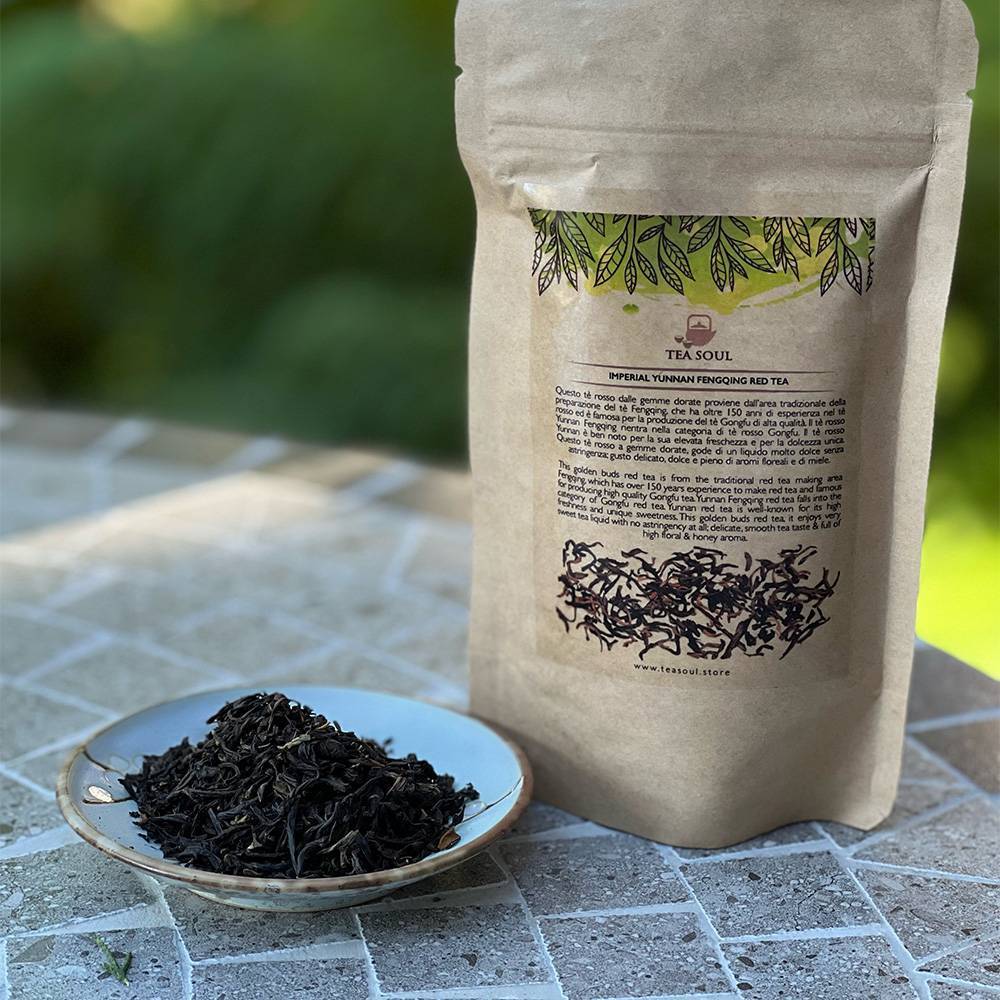
Yunnan Fengqing Imperial is a red tea produced in the Fengqing area of Yunnan, and bears many similarities to another product in our catalog called Yunnan Fengqing Maofeng. Both of these teas have very small leaves picked at the beginning of spring, but this one in particular has a very high number of buds. Another characteristic, somewhat less evident, that differentiates these two products is how their leaves have been shaped: in this case, in particular, a more needle-like shape has been given to the leaves, while in Mao Feng an additional twist similar to that of the homonymous green tea has been done. Although small, these differences still lead to a significant variation in the taste of the two teas. For this reason, we invite you to take both products: you will have the opportunity to brew them and compare them, experiencing the differences with your palate. Yunnan Fengqing Imperial will reveal itself in the cup as a rather complex tea with a rich array of aromas and flavors: from the sweetness of malt, due to the high presence of buds, the tea evolves on the palate ending with an aftertaste that recalls cocoa. The red tea Yunnan Fengqing Imperial has small, whole, and finely rolled leaves. The color is a dark brown-black with numerous golden buds having coppery reflections. Once brewed, the leaves release aromas of cocoa and dark bread crust, floral notes, fruity notes reminiscent of plum and baked apple, and a hint of wood that is almost balsamic. In the cup, the color of the liquor is a rich orange with amber highlights, clear and very bright. The first brew of red tea Yunnan Fengqing Imperial is delicate but already rich in various flavors: the first to be perceived is undoubtedly cocoa, followed by floral notes and very sweet fruity notes that recall lychee. A pleasant and slight spicy note is also felt. With the second brew, the flavors become more intense: the top notes remain bitter cocoa and rose, followed by hints of malt and rye bread. In the end, notes of fragrant wood emerge, along with a slightly tart fruity note reminiscent of plum. The third brew reveals a balsamic taste reminiscent of fir wood and juniper berries, as well as clear spicy notes of black pepper and a sweet note of forest honeydew. Bitter cocoa is always well-present, while floral notes reappear at the finish. The first sip of red tea Yunnan Fengqing Imperial opens with notes of bitter cocoa and floral notes of rose. The evolution on the palate then brings forth hints of wood, such as fir wood and sandalwood, followed by spicy notes like black pepper and cardamom, with its lively and slightly balsamic character. In the finish, the sweetness of malt and cooked fruit (apples) emerge, while the persistence is long, with notes of cocoa and spices enveloping the tongue and palate. This is a complex tea, with an excellent balance and remarkable softness on the palate. After harvesting, the leaves of Yunnan Fengqing Imperial are allowed to wither in the sun for a certain amount of time depending on the producer before going through the folding phase. The leaves are then folded and rolled so that the juices inside are mixed and the oxidation process can begin. For this tea, the leaves are subjected to a gradual temperature increase during oxidation, and once the leaf reaches its typical brown color, the residual internal moisture is removed. After a few days of rest, the tea is ready to be consumed. We highly recommend brewing Yunnan Fengqing Imperial tea using the traditional Chinese method (gong fu cha) to best enjoy these leaves. Following this preparation, with 5 grams of leaves (about 4 teaspoons), several brews can be done to capture all the nuances of the tea's flavor. Heat the water to a temperature of 90-95°C and proceed with a first brew of 25 seconds. Keeping the water at the same temperature, you can then continue to use the same leaves by adding more water and increasing the infusion time by 10 seconds each time (25 - 35 - 45…). This tea has a longevity of 7 brews. For a more classic preparation according to Western style, we recommend 3 grams of leaves in a cup of 200 ml with water at 90-95°C for an infusion time of 2-3 minutes. For a better tasting experience, we suggest filtering the tea immediately after the infusion time is over. The timings we suggest can be slightly modified to your liking to achieve a more or less intense taste. It is recommended to store in a cool, dry place away from direct sunlight.
Price VAT included







Yunnan Fengqing Imperial is a red tea produced in the Fengqing area of Yunnan, and bears many similarities to another product in our catalog called Yunnan Fengqing Maofeng. Both of these teas have very small leaves picked at the beginning of spring, but this one in particular has a very high number of buds. Another characteristic, somewhat less evident, that differentiates these two products is how their leaves have been shaped: in this case, in particular, a more needle-like shape has been given to the leaves, while in Mao Feng an additional twist similar to that of the homonymous green tea has been done. Although small, these differences still lead to a significant variation in the taste of the two teas. For this reason, we invite you to take both products: you will have the opportunity to brew them and compare them, experiencing the differences with your palate. Yunnan Fengqing Imperial will reveal itself in the cup as a rather complex tea with a rich array of aromas and flavors: from the sweetness of malt, due to the high presence of buds, the tea evolves on the palate ending with an aftertaste that recalls cocoa. The red tea Yunnan Fengqing Imperial has small, whole, and finely rolled leaves. The color is a dark brown-black with numerous golden buds having coppery reflections. Once brewed, the leaves release aromas of cocoa and dark bread crust, floral notes, fruity notes reminiscent of plum and baked apple, and a hint of wood that is almost balsamic. In the cup, the color of the liquor is a rich orange with amber highlights, clear and very bright. The first brew of red tea Yunnan Fengqing Imperial is delicate but already rich in various flavors: the first to be perceived is undoubtedly cocoa, followed by floral notes and very sweet fruity notes that recall lychee. A pleasant and slight spicy note is also felt. With the second brew, the flavors become more intense: the top notes remain bitter cocoa and rose, followed by hints of malt and rye bread. In the end, notes of fragrant wood emerge, along with a slightly tart fruity note reminiscent of plum. The third brew reveals a balsamic taste reminiscent of fir wood and juniper berries, as well as clear spicy notes of black pepper and a sweet note of forest honeydew. Bitter cocoa is always well-present, while floral notes reappear at the finish. The first sip of red tea Yunnan Fengqing Imperial opens with notes of bitter cocoa and floral notes of rose. The evolution on the palate then brings forth hints of wood, such as fir wood and sandalwood, followed by spicy notes like black pepper and cardamom, with its lively and slightly balsamic character. In the finish, the sweetness of malt and cooked fruit (apples) emerge, while the persistence is long, with notes of cocoa and spices enveloping the tongue and palate. This is a complex tea, with an excellent balance and remarkable softness on the palate. After harvesting, the leaves of Yunnan Fengqing Imperial are allowed to wither in the sun for a certain amount of time depending on the producer before going through the folding phase. The leaves are then folded and rolled so that the juices inside are mixed and the oxidation process can begin. For this tea, the leaves are subjected to a gradual temperature increase during oxidation, and once the leaf reaches its typical brown color, the residual internal moisture is removed. After a few days of rest, the tea is ready to be consumed. We highly recommend brewing Yunnan Fengqing Imperial tea using the traditional Chinese method (gong fu cha) to best enjoy these leaves. Following this preparation, with 5 grams of leaves (about 4 teaspoons), several brews can be done to capture all the nuances of the tea's flavor. Heat the water to a temperature of 90-95°C and proceed with a first brew of 25 seconds. Keeping the water at the same temperature, you can then continue to use the same leaves by adding more water and increasing the infusion time by 10 seconds each time (25 - 35 - 45…). This tea has a longevity of 7 brews. For a more classic preparation according to Western style, we recommend 3 grams of leaves in a cup of 200 ml with water at 90-95°C for an infusion time of 2-3 minutes. For a better tasting experience, we suggest filtering the tea immediately after the infusion time is over. The timings we suggest can be slightly modified to your liking to achieve a more or less intense taste. It is recommended to store in a cool, dry place away from direct sunlight.