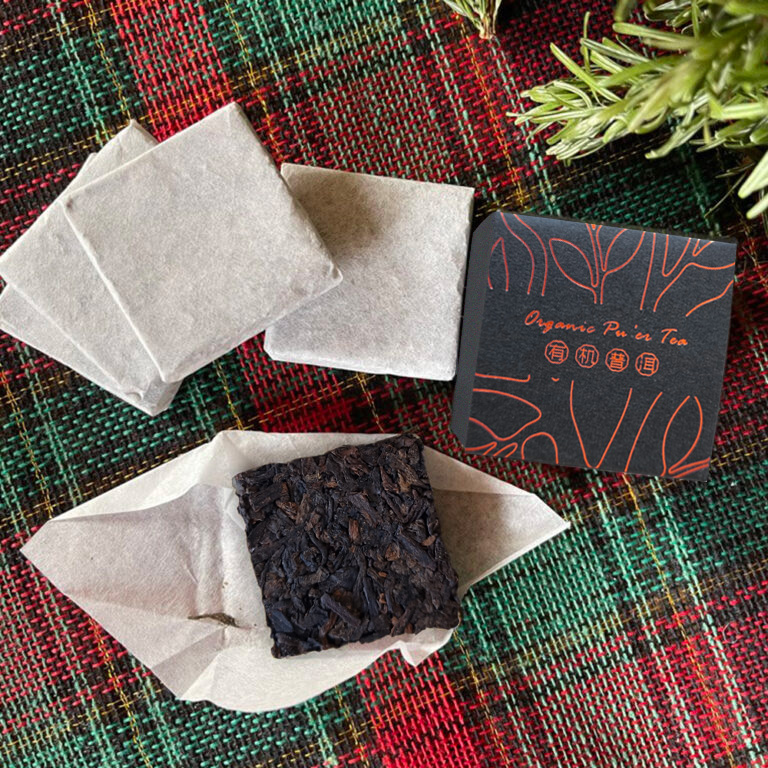
The organic shu puer tea (ripe) in mini portions is a very practical product, as it is sold in convenient single doses in a square shape or small bowl (called Tuo in China). Both formats of this tea are made with leaves from the mountainous area of Wuliang, located near the city of Dali in the central-western part of Yunnan. The squares are packaged in a paper pack of 2 pieces weighing 20 g each, while the Tuo are found in a cloth bag weighing about 120 grams, containing around twenty pieces. The puer pressed into small squares allows for a better view of the dried leaves and modifies the flavors in case of multiple infusions, while the mini Tuo releases its taste more immediately and intensely. Regarding flavors, the mini portions of shu puer have a fairly persistent fermented taste, capable of expressing itself in different ways on the palate. In the first sips, in fact, a very intense sweet flavor is felt, followed by various shades of a fermented character and a fairly sustained body. In this case, the fermentation process results in a light herbal liqueur taste, with hints of wood and a slightly balsamic finish. Given the described characteristics, the infusion of this puer in a convenient format represents very well the typical traits of the category of cooked products or shu. Shu Puer Tea Mini portion 40 g (the pack contains 2 mini square doses of 20 g each). Shu Puer Tea Mini Tuo: pack 120 g (about twenty pieces). Place of origin: Wuliang - Yunnan, China. Production: After harvest, the leaves are allowed to wither in the sun for a certain time depending on the producer, before moving on to the "kill green" phase, which is similar to that used for green tea production. The peculiarity in this case lies in not heating the leaves as much as is done for green tea, thus preserving some enzymes that can modify the flavors over time. Once cooked, the leaves are taken in large quantities and piled up to form large mounds. This vegetation mass is then moistened and covered with cloths, so that heat can be retained and the fermentation process can begin. Here, the producer must skillfully move the leaves and lightly wet them, so that fermentation proceeds steadily and distributes as evenly as possible. Once this processing is complete, which can last from 20 to 70 days, the leaves are spread out and left in contact with the air so that the microorganisms responsible for fermentation dry up and die, leaving the finished product. At this point, it is possible (if desired) to press the puer to give it the best conditions for transport and aging. To press the leaves, they are subjected for a few seconds to a strong jet of steam, so that they become soft on the outside, and then pressed into their small bowl or square shape. To ensure that this structure remains fixed over time, the bag is left for hours under a stone or a mechanical press, while the leaves lose that residual moisture taken from the steam in the previous phase. Preparation: We recommend infusing this tea using the traditional Chinese method (gong fu cha) to best enjoy these leaves. Following this preparation, one can place a mini Tuo or square in a gaiwan of about 100 ml to achieve more infusions with different flavors. After a brief preliminary rinse at 100°C, one can proceed with a first infusion of 10 seconds and, subsequently, while keeping the water at the same temperature, can increase the time by 5 seconds each time compared to the previous infusion (10 - 15 - 20...). This tea has a longevity of about 7 infusions. For a classic preparation, according to Western style, we recommend a mini Tuo in a 200 ml cup with water at 100°C for an infusion time of two minutes. It would be preferable to still do a preliminary rinse of about 15 seconds, to make the most of the flavors of the leaves more inside the Tuo or square. The tea can be filtered for greater ease during tasting, and the indicated infusion times are meant to be purely indicative, so one can adjust according to personal taste. It is recommended to store in a cool, dry place, away from direct sunlight.
Price VAT included







The organic shu puer tea (ripe) in mini portions is a very practical product, as it is sold in convenient single doses in a square shape or small bowl (called Tuo in China). Both formats of this tea are made with leaves from the mountainous area of Wuliang, located near the city of Dali in the central-western part of Yunnan. The squares are packaged in a paper pack of 2 pieces weighing 20 g each, while the Tuo are found in a cloth bag weighing about 120 grams, containing around twenty pieces. The puer pressed into small squares allows for a better view of the dried leaves and modifies the flavors in case of multiple infusions, while the mini Tuo releases its taste more immediately and intensely. Regarding flavors, the mini portions of shu puer have a fairly persistent fermented taste, capable of expressing itself in different ways on the palate. In the first sips, in fact, a very intense sweet flavor is felt, followed by various shades of a fermented character and a fairly sustained body. In this case, the fermentation process results in a light herbal liqueur taste, with hints of wood and a slightly balsamic finish. Given the described characteristics, the infusion of this puer in a convenient format represents very well the typical traits of the category of cooked products or shu. Shu Puer Tea Mini portion 40 g (the pack contains 2 mini square doses of 20 g each). Shu Puer Tea Mini Tuo: pack 120 g (about twenty pieces). Place of origin: Wuliang - Yunnan, China. Production: After harvest, the leaves are allowed to wither in the sun for a certain time depending on the producer, before moving on to the "kill green" phase, which is similar to that used for green tea production. The peculiarity in this case lies in not heating the leaves as much as is done for green tea, thus preserving some enzymes that can modify the flavors over time. Once cooked, the leaves are taken in large quantities and piled up to form large mounds. This vegetation mass is then moistened and covered with cloths, so that heat can be retained and the fermentation process can begin. Here, the producer must skillfully move the leaves and lightly wet them, so that fermentation proceeds steadily and distributes as evenly as possible. Once this processing is complete, which can last from 20 to 70 days, the leaves are spread out and left in contact with the air so that the microorganisms responsible for fermentation dry up and die, leaving the finished product. At this point, it is possible (if desired) to press the puer to give it the best conditions for transport and aging. To press the leaves, they are subjected for a few seconds to a strong jet of steam, so that they become soft on the outside, and then pressed into their small bowl or square shape. To ensure that this structure remains fixed over time, the bag is left for hours under a stone or a mechanical press, while the leaves lose that residual moisture taken from the steam in the previous phase. Preparation: We recommend infusing this tea using the traditional Chinese method (gong fu cha) to best enjoy these leaves. Following this preparation, one can place a mini Tuo or square in a gaiwan of about 100 ml to achieve more infusions with different flavors. After a brief preliminary rinse at 100°C, one can proceed with a first infusion of 10 seconds and, subsequently, while keeping the water at the same temperature, can increase the time by 5 seconds each time compared to the previous infusion (10 - 15 - 20...). This tea has a longevity of about 7 infusions. For a classic preparation, according to Western style, we recommend a mini Tuo in a 200 ml cup with water at 100°C for an infusion time of two minutes. It would be preferable to still do a preliminary rinse of about 15 seconds, to make the most of the flavors of the leaves more inside the Tuo or square. The tea can be filtered for greater ease during tasting, and the indicated infusion times are meant to be purely indicative, so one can adjust according to personal taste. It is recommended to store in a cool, dry place, away from direct sunlight.