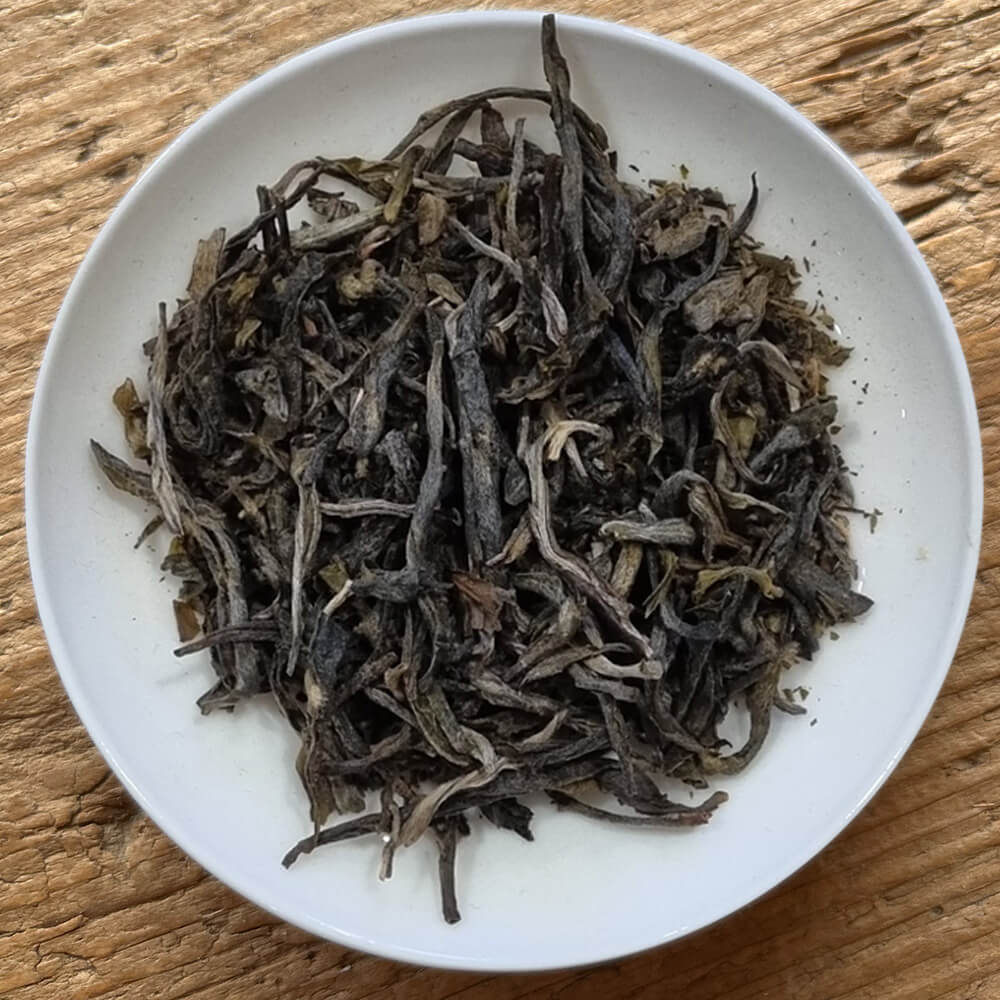
The leaves of the puer sheng (raw) Menghai spring 2019 come from the Menghai area, located in the Yunnan region in southern China. To better understand this product, it is necessary to delve into the origin area of its leaves, since, in most cases, it is the place of origin itself that gives the name and the main organoleptic qualities to the tea. This puer, specifically, is mainly composed of the harvest made in the vast Menghai area to the west of the Xishuangbanna autonomous prefecture in the extreme south of Yunnan. The leaves were harvested in 2013 and then carefully selected and pressed in the spring of 2019 by the Menghai Shenyu factory, located in Menghai County. The indication of the factory where the leaves arrive is useful to emphasize that behind this puer there is a specific style or type of research studied by a dedicated group of tea masters to enhance the territorial characteristics of the product. On the palate, the Sheng Menghai Spring presents a vegetal character enriched by slightly acidic notes, similar to those of an underripe citrus. This last characteristic is a factor often found in puer around the year of aging and is indicative of the maturation phase of the product. Despite the taste factor linked to the very young age, the body of the drink remains soft on the sip, while in the aftertaste there is a sensation of slight dryness, due to the high presence of minerals in the leaves. Compared to other puer, this one does not show a particular sweetness but only a slight savoriness, linked to the vegetal flavors of the infusion. The most interesting point of this product remains, in fact, the mineral sensation that can be perceived very intensely at the back of the mouth once the tasting is finished. Place of origin: Menghai - Yunnan, China. After harvesting, the leaves are left to wither in the sun for a certain time, at the discretion of the producer, before moving on to the oxidation blocking phase, similar to that used to produce green tea. The peculiarity, in this case, lies in not heating the leaves as is done for green tea, in order to preserve certain enzymes capable of modifying flavors over time. Once cooked, the leaves are left to rest overnight before completing sun drying. At this stage, the product is called maocha and is ready to be pressed, in order to obtain the best conditions for transport and aging. To press the leaves, they are exposed for a few seconds to a strong jet of steam, in order to soften them externally; subsequently, they are collected in a stocking or bag that will give shape, usually disc-shaped, to the product. To ensure that this structure remains fixed over time, the bag is left for hours under a stone or a mechanical press, while the leaves lose that residual moisture absorbed by the steam in the previous phase. We strongly recommend infusing this tea using the traditional Chinese method (Gong Fu Cha) with a gaiwan with a capacity of about 150 ml. By following this preparation, with 5 grams of leaves, multiple infusions can be made to capture all the flavor nuances of the tea. Heat the water to a temperature of 90°C: proceed with a brief rinse of the leaves and then to a first infusion of 20 seconds. Keeping the water at the same temperature, you can then continue to use the same leaves, adding more water and increasing the infusion time by 5 seconds each time (20-25-30…). This tea has a longevity of 8 infusions. For a more classic preparation according to the Western style, we recommend 2.5 grams of leaves in a 200 ml cup with water at 90°C for an infusion time of 2 and a half minutes. For a better tasting experience, we suggest filtering the tea immediately after the infusion time is over. The infusion times we suggested can be slightly modified to your liking to achieve a more or less intense taste. It is advisable to store in a cool and dry place, away from direct sunlight.
Price VAT included







The leaves of the puer sheng (raw) Menghai spring 2019 come from the Menghai area, located in the Yunnan region in southern China. To better understand this product, it is necessary to delve into the origin area of its leaves, since, in most cases, it is the place of origin itself that gives the name and the main organoleptic qualities to the tea. This puer, specifically, is mainly composed of the harvest made in the vast Menghai area to the west of the Xishuangbanna autonomous prefecture in the extreme south of Yunnan. The leaves were harvested in 2013 and then carefully selected and pressed in the spring of 2019 by the Menghai Shenyu factory, located in Menghai County. The indication of the factory where the leaves arrive is useful to emphasize that behind this puer there is a specific style or type of research studied by a dedicated group of tea masters to enhance the territorial characteristics of the product. On the palate, the Sheng Menghai Spring presents a vegetal character enriched by slightly acidic notes, similar to those of an underripe citrus. This last characteristic is a factor often found in puer around the year of aging and is indicative of the maturation phase of the product. Despite the taste factor linked to the very young age, the body of the drink remains soft on the sip, while in the aftertaste there is a sensation of slight dryness, due to the high presence of minerals in the leaves. Compared to other puer, this one does not show a particular sweetness but only a slight savoriness, linked to the vegetal flavors of the infusion. The most interesting point of this product remains, in fact, the mineral sensation that can be perceived very intensely at the back of the mouth once the tasting is finished. Place of origin: Menghai - Yunnan, China. After harvesting, the leaves are left to wither in the sun for a certain time, at the discretion of the producer, before moving on to the oxidation blocking phase, similar to that used to produce green tea. The peculiarity, in this case, lies in not heating the leaves as is done for green tea, in order to preserve certain enzymes capable of modifying flavors over time. Once cooked, the leaves are left to rest overnight before completing sun drying. At this stage, the product is called maocha and is ready to be pressed, in order to obtain the best conditions for transport and aging. To press the leaves, they are exposed for a few seconds to a strong jet of steam, in order to soften them externally; subsequently, they are collected in a stocking or bag that will give shape, usually disc-shaped, to the product. To ensure that this structure remains fixed over time, the bag is left for hours under a stone or a mechanical press, while the leaves lose that residual moisture absorbed by the steam in the previous phase. We strongly recommend infusing this tea using the traditional Chinese method (Gong Fu Cha) with a gaiwan with a capacity of about 150 ml. By following this preparation, with 5 grams of leaves, multiple infusions can be made to capture all the flavor nuances of the tea. Heat the water to a temperature of 90°C: proceed with a brief rinse of the leaves and then to a first infusion of 20 seconds. Keeping the water at the same temperature, you can then continue to use the same leaves, adding more water and increasing the infusion time by 5 seconds each time (20-25-30…). This tea has a longevity of 8 infusions. For a more classic preparation according to the Western style, we recommend 2.5 grams of leaves in a 200 ml cup with water at 90°C for an infusion time of 2 and a half minutes. For a better tasting experience, we suggest filtering the tea immediately after the infusion time is over. The infusion times we suggested can be slightly modified to your liking to achieve a more or less intense taste. It is advisable to store in a cool and dry place, away from direct sunlight.