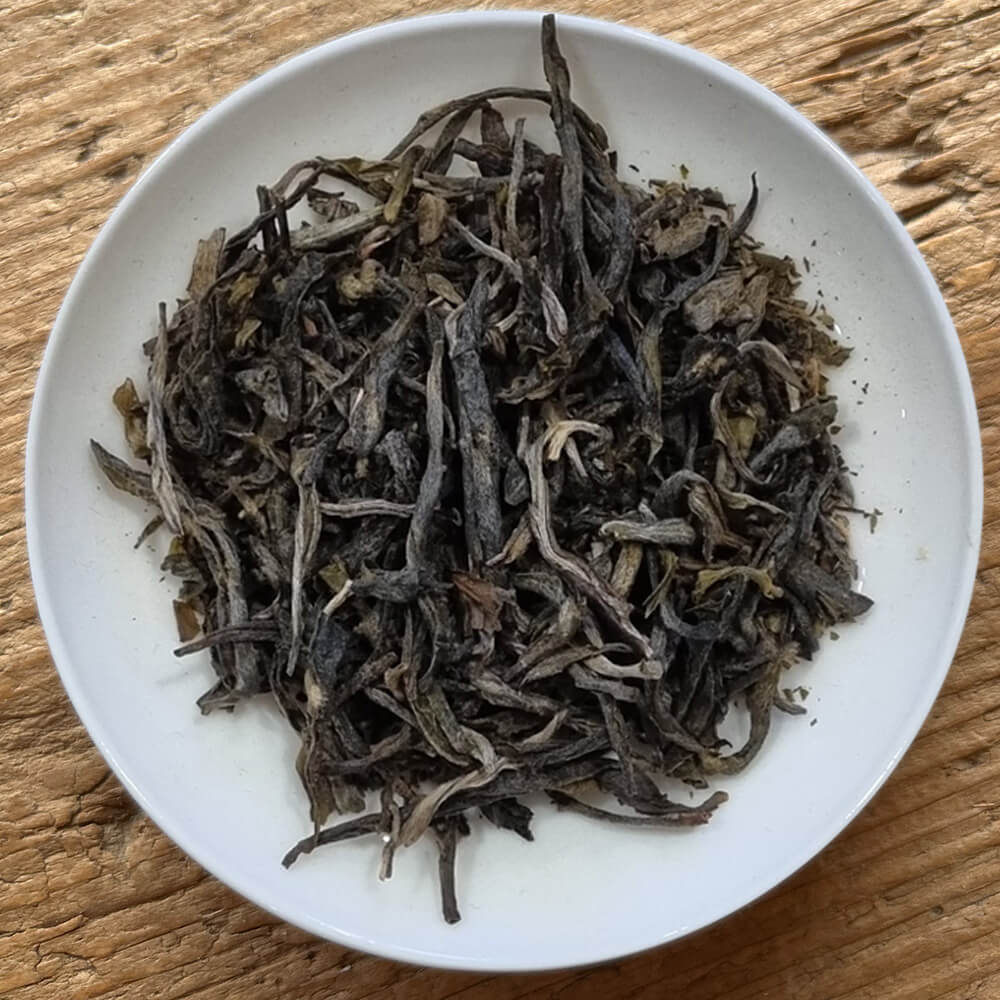
The leaves of the puer shu tea Yi Pin Chayun brick 2008 come from the areas of Bulang and Nannuo, located in southern China. To frame the category of puer teas, we need to better explain the area where these teas grow, as in most cases it is the area itself that gives the distinctive name to each tea. In our case, we are in the eastern part of the Yunnan region, famous for the production of puer, in an autonomous prefecture called Xishuangbanna. Here, in the Menghai region, this brick was produced in 2008 by the Yi Pin Tang factory with a precise recipe to create this product ad hoc. Given the two major areas of origin of the leaves that make up this brick, we will have an infusion particularly rich in very varied flavors. Tasting the tea in a cup, indeed, we will first notice a dry, almost metallic note, followed by a taste of barrel wood that will shortly reveal floral notes of lavender, very particular for a shu puer. In addition to these characteristics, there will be a slight taste of damp earth and a mineral note that will leave a sensation of freshness on the palate in the aftertaste. Production After harvesting, the leaves of the puer shu tea Yi Pin Chayun brick 2008 are left to wither in the sun for a certain period at the discretion of the producer, before moving on to the phase of blocking oxidation, similar to that used for producing green teas. The peculiarity in this case lies in not heating the leaves as much as one does for green tea, in order to preserve some enzymes that will change the flavors over time. Once cooked, the leaves are collected in large quantities and piled up to a height of about 40/50 centimeters, then covered by a cloth, under which the fermentation process will take place. Here, the producer will need to skillfully move the leaves and moisten them gradually, to ensure that fermentation progresses steadily and distributes as homogeneously as possible. Once this processing is completed, which can take from 20 to 70 days, the leaves are spread out and left in contact with the air, so that the microorganisms dry and die, leaving the finished product. The mass of leaves obtained will be pressed to favor better conditions for transport and aging. To press the leaves, they are subjected to a strong jet of steam, which can soften them externally without altering their internal humidity. Once this state is reached, it is enough to put them in a bag and close it very tightly around them to give it the desired shape. To fix this shape over time, the bag is left for hours under a stone or a mechanical press, while the leaves lose the steam with which they were in contact in the previous phase. Preparation We strongly recommend infusing the puer shu tea Yi Pin Chayun brick 2008 using the traditional Chinese method (gong fu cha) to best enjoy these leaves. Following this preparation, you can use 5 grams of leaves in a gaiwan of about 150 ml to obtain multiple infusions with different tastes. After a quick rinse of the leaves in water at 95-98°C, you can proceed to a first infusion of 20 seconds and, after that, keeping the water at the same temperature, you can proceed increasing the time by 5 seconds each time compared to the previous infusion (20 – 25 – 30 …). This tea has a longevity of about 9 infusions. For a classic preparation according to Western style, we recommend 3 grams of leaves in a 200 ml cup with water at 95-98°C for an infusion time of 3 minutes. The tea can be filtered for easier tasting; also, the infusion times stated above are meant to be purely indicative, therefore one can adjust according to personal taste. It is recommended to store in a cool, dry place, away from direct sunlight.
Price VAT included







The leaves of the puer shu tea Yi Pin Chayun brick 2008 come from the areas of Bulang and Nannuo, located in southern China. To frame the category of puer teas, we need to better explain the area where these teas grow, as in most cases it is the area itself that gives the distinctive name to each tea. In our case, we are in the eastern part of the Yunnan region, famous for the production of puer, in an autonomous prefecture called Xishuangbanna. Here, in the Menghai region, this brick was produced in 2008 by the Yi Pin Tang factory with a precise recipe to create this product ad hoc. Given the two major areas of origin of the leaves that make up this brick, we will have an infusion particularly rich in very varied flavors. Tasting the tea in a cup, indeed, we will first notice a dry, almost metallic note, followed by a taste of barrel wood that will shortly reveal floral notes of lavender, very particular for a shu puer. In addition to these characteristics, there will be a slight taste of damp earth and a mineral note that will leave a sensation of freshness on the palate in the aftertaste. Production After harvesting, the leaves of the puer shu tea Yi Pin Chayun brick 2008 are left to wither in the sun for a certain period at the discretion of the producer, before moving on to the phase of blocking oxidation, similar to that used for producing green teas. The peculiarity in this case lies in not heating the leaves as much as one does for green tea, in order to preserve some enzymes that will change the flavors over time. Once cooked, the leaves are collected in large quantities and piled up to a height of about 40/50 centimeters, then covered by a cloth, under which the fermentation process will take place. Here, the producer will need to skillfully move the leaves and moisten them gradually, to ensure that fermentation progresses steadily and distributes as homogeneously as possible. Once this processing is completed, which can take from 20 to 70 days, the leaves are spread out and left in contact with the air, so that the microorganisms dry and die, leaving the finished product. The mass of leaves obtained will be pressed to favor better conditions for transport and aging. To press the leaves, they are subjected to a strong jet of steam, which can soften them externally without altering their internal humidity. Once this state is reached, it is enough to put them in a bag and close it very tightly around them to give it the desired shape. To fix this shape over time, the bag is left for hours under a stone or a mechanical press, while the leaves lose the steam with which they were in contact in the previous phase. Preparation We strongly recommend infusing the puer shu tea Yi Pin Chayun brick 2008 using the traditional Chinese method (gong fu cha) to best enjoy these leaves. Following this preparation, you can use 5 grams of leaves in a gaiwan of about 150 ml to obtain multiple infusions with different tastes. After a quick rinse of the leaves in water at 95-98°C, you can proceed to a first infusion of 20 seconds and, after that, keeping the water at the same temperature, you can proceed increasing the time by 5 seconds each time compared to the previous infusion (20 – 25 – 30 …). This tea has a longevity of about 9 infusions. For a classic preparation according to Western style, we recommend 3 grams of leaves in a 200 ml cup with water at 95-98°C for an infusion time of 3 minutes. The tea can be filtered for easier tasting; also, the infusion times stated above are meant to be purely indicative, therefore one can adjust according to personal taste. It is recommended to store in a cool, dry place, away from direct sunlight.